How Innovative Materials Perform Outside the Lab
A timber floor panel arrives on site ready to lift into place. In a different factory, a packaging team is trying to stop moisture softening a paper tray. Both teams are working with innovative materials, and both have to answer a deceptively ordinary question. How will the finished product behave on the day someone needs it? The answer can change with the weather, the production line or what happens after use. Look at construction, packaging, vehicles and medical devices side by side and you start to see why the conditions of the test matter as much as the result.
Think of how a team working on a digital product might test the same control on several screen sizes. For an online casino such as Spinanzia Australia, that might mean checking whether a menu stays easy to find on a phone as well as a laptop. Engineers take a similar approach when they change the conditions around a material. A dry sample can tell them how an adhesive bonds in the lab. A wet sample can help them see what happens if that bond faces a rainy week on site.
What innovative building materials have to prove
Cross-laminated timber, or CLT, gets its structure from layers of boards laid at right angles and bonded into a panel. The panels can be cut in a factory for walls or floors. What matters on site is how the assembled system performs, from the way it carries loads to how it handles moisture around joints. A panel that arrives as planned can still sit exposed in the rain. How the team keeps it dry during storage and installation matters to the finished building.
Concrete offers a different example. Using calcined clay in a cement blend can reduce the amount of clinker needed. The design team still needs evidence for the mix it plans to use, including how quickly it develops strength and how it stands up to its exposure conditions. A saving in embodied carbon is most useful when the comparison covers mixes that can deliver the same service. The ICMI 2023 themes give readers a wider view of the environmental and manufacturing questions behind such comparisons.
Would the result still hold after a week of rain, or once the material is joined to the rest of the structure?
The job of innovative packaging materials
A paper tray looks straightforward until it has to hold food through packing, transport and storage. A barrier coating may keep grease or moisture away from the fibres. That same coating can change how easily a recycling mill can separate or recover those fibres. A fair trial follows the whole pack, including the lid, label and adhesive, through the route available to the people who actually use it.
The Australian Packaging Covenant Organisation’s Sustainable Packaging Guidelines cover both product protection and recovery. A team comparing two packs can use those aims to decide what evidence to gather. These checks give a more practical picture than the material name on the sleeve.
- Check whether the pack protects its contents through the expected shelf life.
- Run a packing-line trial to see whether seals hold consistently.
- Test the finished pack after realistic handling and transport.
- Check whether a sorting facility and mill can handle the complete pack.
- Review disposal instructions against the collection service available to customers.
Where vehicle and medical applications part ways
Researchers working on innovative automotive materials often aim to cut weight while preserving the performance of a specific part. Advanced high-strength steel can allow a thinner section in some designs. Aluminium may suit another part, depending on its shape and what it joins to. Joining aluminium to steel introduces questions about fasteners, corrosion and repair. Those details affect the decision long after a comparison of sample weights is over.
With innovative medical materials, the shape of the finished device and the way it is made deserve close attention. Additive manufacturing can produce porous titanium structures for some orthopaedic implants. Engineers evaluate properties such as fatigue strength, while manufacturers need a way to control variation between builds. A porous coupon can help researchers investigate the design. Evidence for a finished implant needs to address the device itself and its intended use.
| Application | Example | What the team needs to check |
|---|---|---|
| Construction | CLT floor panel | Moisture at joints during installation |
| Packaging | Coated fibre tray | Protection in transit and compatibility with recovery |
| Automotive | Aluminium body part | Joint durability, corrosion and repair |
| Medical devices | Porous titanium implant | Fatigue performance in the intended design |
What makes innovative sustainable materials worth adopting
Comparing materials on environmental grounds starts with agreeing on the service they have to deliver. A tonne of one material and a tonne of another may do different amounts of work. A floor that spans the same space for the same period gives the team a common basis for comparing manufacture, maintenance and replacement. The choice of boundary also matters. Leaving out repairs or the energy required to recycle a material can change the apparent winner.
| Decision | Useful evidence | Question to ask |
|---|---|---|
| Source | Supplier and manufacturing data | How much variation is there between batches? |
| Use | Durability and maintenance tests | How long will the product serve? |
| Repair | Inspection and replacement trials | Can a damaged part be reached and replaced? |
| Recovery | Local collection and sorting information | Where can the finished product actually go? |
Promising results can justify a pilot. A good pilot gives the people who will make, fit, clean or repair the product a chance to handle it. The team can then see which assumptions hold once the material leaves the lab.
- Choose one product and define what it has to do.
- Set the same baseline for the current and proposed materials.
- Record where the pilot conditions differ from normal use.
- Ask operators to note where they needed extra time or effort.
- Document what would need another trial before a wider rollout.
At a conference, it’s easy to remember the striking sample and forget the test behind it. An audience member can learn more by asking what changed between the first trial and the result on the slide.
Where did the material work, and what had to change around it?
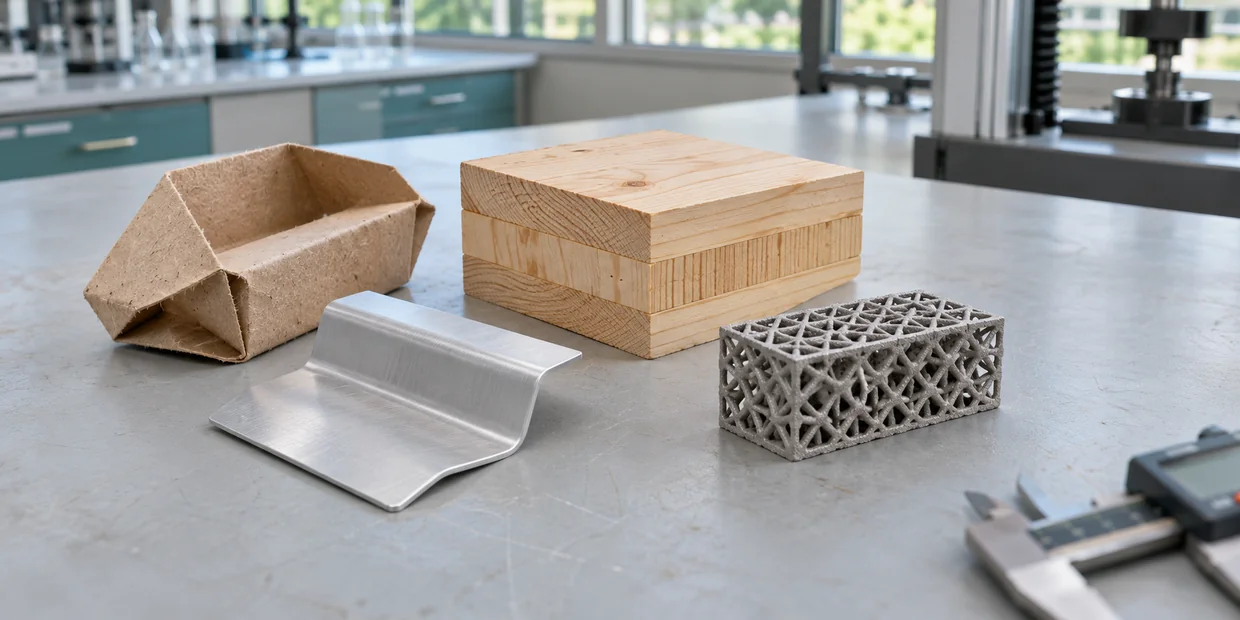
The timber panel, the coated tray, the vehicle part and the printed lattice all solve different problems. The useful comparison is how precisely each team links a material to a job, then tests it in the conditions where that job takes place. A failed seal or a difficult joint can send a team back to the bench with a better question. That feedback is often what moves an idea from a conference poster into everyday use.
Sources
- WoodSolutions, Cross-Laminated Timber (CLT) Guide
https://www.woodsolutions.com.au/timber-wiki/cross-laminated-timber-clt-guide - NSW Government, Supplementary Cementitious Materials
https://www.energy.nsw.gov.au/sites/default/files/2025-04/2025%20NSW%20%20A4%20Factsheet_Supplementary%20Cementitious%20Materials.pdf - Australian Packaging Covenant Organisation, Sustainable Packaging Guidelines
https://apco.org.au/sustainable-packaging-guidelines/ - US Department of Energy, Short-Term Lightweight Materials Research
https://www.energy.gov/cmei/vehicles/short-term-lightweight-materials-research-advanced-high-strength-steel-and-aluminum - US Food and Drug Administration, Process of 3D Printing Medical Devices
https://www.fda.gov/medical-devices/3d-printing-medical-devices/process-3d-printing-medical-devices - PubMed, Fatigue performance of additively manufactured porous titanium for orthopaedic applications
https://pubmed.ncbi.nlm.nih.gov/41861698/ - European Commission, Safe and sustainable by design
https://research-and-innovation.ec.europa.eu/research-area/industrial-research-and-innovation/safe-and-sustainable-design_en